

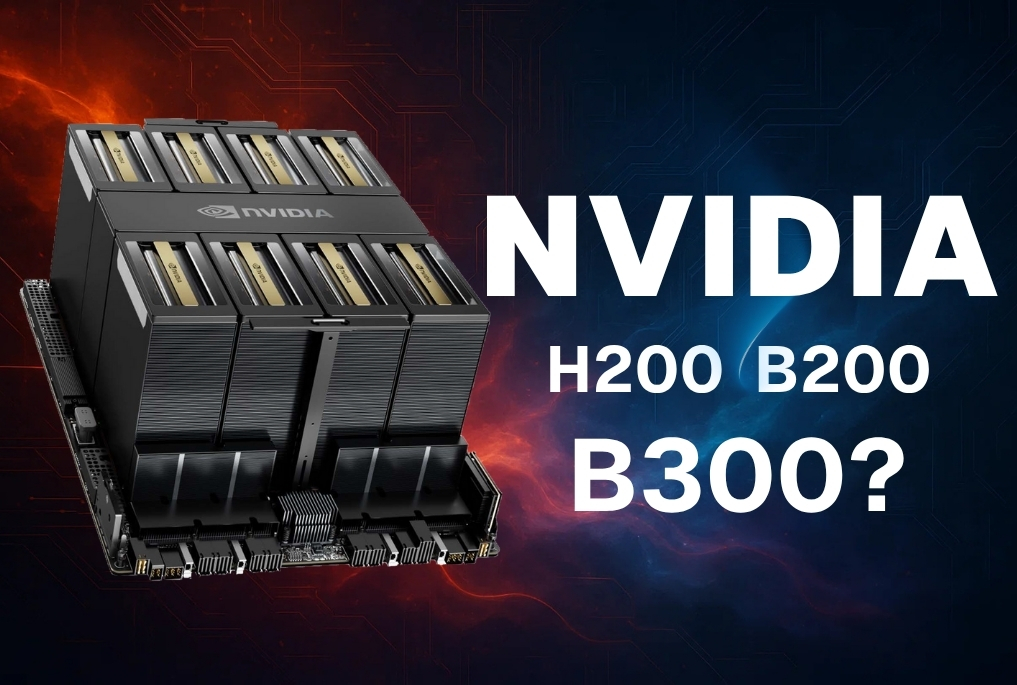
Choosing the right GPU platform is a strategic decision for AI teams. NVIDIA’s HGX B200 (Blackwell) represents the latest scale-up approach, while previous generations (H200/H100) and other architectures (A100, B100 variants) remain relevant for different workloads. This article compares them across performance, memory & bandwidth, and typical use cases; to help engineering and procurement teams decide which platform fits their needs.
Briefly — key differences
1. HGX B200 (Blackwell):
Designed for extreme-scale training and inference with very large models; high per-GPU memory and NVSwitch/NVLink bandwidth for fast multi-GPU communication.
2. H200 / H100 (Hopper generation):
Strong, balanced performer for many LLM training and inference tasks; widely deployed and supported across clouds.
3. A100 (Ampere):
Earlier datacentre staple; excellent FP32/FP16 performance but limited VRAM compared with newer generations.
4. B100 / B200 family:
Variants and evolution lines overlap (B-series focuses on Blackwell improvements in memory and efficiency).
Performance: raw compute and throughput
HGX B200 targets orders-of-magnitude gains for large language models and multi-GPU workloads, especially in FP8/FP6 tensor throughput that benefits huge transformer models. Benchmarks and manufacturer guidance show significant throughput and latency improvements versus Hopper hardware for large sequence lengths and batch sizes.
H200/H100 remain strong for general-purpose training and are often more cost-effective for mid-sized models or mixed workloads. Many production clusters still rely on H100/H200 for balancing price/performance.
A100 provides robust performance for legacy pipelines and double-precision workloads, but it falls behind in memory capacity and FP8 optimizations compared with newer chips.
Memory & Interconnect: why it matters
High-memory GPUs reduce off-GPU communication and memory paging, a critical advantage for very large models.
1. Per-GPU memory:
B200 GPUs ship with very large HBM3E pools (example configurations show ~180 GB per GPU in an 8-GPU HGX board), enabling single-GPU training of much larger model shards.
2. Aggregate memory & NVLink/NVSwitch:
An eight-GPU HGX B200 board can present up to ~1.4 TB total fast memory and terabytes/sec of NVLink switch bandwidth—designed to keep parameter exchanges fast across GPUs. This dramatically reduces the need for off-node data movement in scale-up training.
3. Comparative note:
Hopper cards (H100/H200) offer less VRAM per GPU and lower NVSwitch totals, which can force model parallelism strategies that increase complexity and training time for the largest LLMs.
Use cases — matching hardware to workload
1. HGX B200 (Blackwell)
Best for extreme-scale LLM training, multi-node model parallelism, high-throughput real-time inference, and organizations seeking to minimise communication bottlenecks. Ideal when memory or NVLink bandwidth is the gating factor.
2. H200 / H100
Strong choice for general LLM training, many production inference fleets, and teams that need broad cloud availability and proven tooling support. Good balance of price and performance.
3. A100 & earlier
Suited to existing pipelines, mixed-precision workloads where extreme memory is not required, and environments prioritising cost over ultra-large model capability.
Conclusion
HGX B200 is a generational leap for scale-up AI workloads, delivering far greater memory and interconnect capacity that simplifies training of huge models. However, alternative architectures still hold strong for many production and cost-conscious scenarios. Match your choice to model size, throughput needs, and operational constraints—and plan for infrastructure changes if moving to ultra-dense HGX deployments.